
Tag: multi speciality hospital

Right Doctor in Ahmedabad
Doctor

How to Choose the Right Doctor in Ahmedabad for Your Health Problem

Selecting the appropriate physician is possibly the most important health-related choice you are going to make. In a busy medical city such as Ahmedabad with the presence of modern multi-specialty hospitals and multi-generational family clinics, so many choices can be disheartening. It is imperative to find a medical collaborator with whom you can get along quite well, be it a sudden fever or a chronic illness like diabetes. This guide will take you on a step by step journey of navigating the Ahmedabad healthcare environment to ensure that you get the doctor most suitable to the exact situations you encounter. 1. Start with the “Gatekeeper”: General Physician vs. Specialist You have to calculate what level of care you require before you just enter a Google search. This is referred to in medical terms as triage. When to See a General Physician (GP) The first one is a general physician (or internal medicine specialist). Imagine that they are your health project manager. Treats: Seasonal flu, minor infections, general health, and common colds. Why start here? A GP is often able to deal with many health issues that appear to be complicated. When it is more severe, they will make a referral to the appropriate specialist, which will save time and money. When to Go Straight to a Specialist You must have a specialist in case you have a pre-existing condition or some symptoms concerning a certain organ. Cardiologist: In case of chest pain or heart. Orthopedic: In case of pain in the joint or bone trauma. Endocrinologist: In the treatment of thyroid or diabetes. 2. Verify Credentials and Experience Check Educational Background Find such degrees as an MBBS and then an MD or MS in their area. Super-specialists seek DM or MCh. Also in 2026, a significant number of doctors possess international fellowships (such as MRCP or FACS) which means that they have been trained in international medical practices. Years of Practice in Ahmedabad A younger doctor can be more technologically advanced, but an experienced doctor has encountered more variations of cases. When chronic illness is treated, 10-15+ years of experience can make a doctor have a more intuitive understanding of the way various bodies respond to extended medicine usage. 3. Evaluate Hospital Infrastructure and Accreditation The only good doctor is one who is well equipped. Ahmedabad offers both standalone clinics and multi-specialty hospitals of large size. The NABH and JCI Gold Standards In doing research, you need to know whether the hospital is accredited by NABH (National Accreditation Board for Hospitals). In case you want international standards, international accreditation is commonly seen in such hospitals as Apollo, Zydus, or Shalby. This also makes sure that the facility adheres to the strict safety and hygiene requirements. Diagnostic Facilities Select a physician who works in a facility that has in-house testing equipment (MRI, CT scans and sophisticated pathology laboratories). This removes the necessity of travelling far in other sections of the city such as Satellite, C.G. Road or S.G. Highway to take a blood test. 4. The “Soft Skills” Test: Communication and Empathy The medicine in 2026 is heading towards patient-focused care. This implies that the physician must offer treatment on you rather than on your symptoms. Do they listen? In Ahmedabad, you will find a good doctor who will allow you to complete your term and not interrupt. Language Comfort: A large number of patients in Ahmedabad will refer to those doctors who can communicate in Gujarati or Hindi in explaining the complex issues they have. The doctor should be a native of the heart only, in case you feel most at home speaking your own language. Transparency: Does the doctor give a reason as to why they order a prescription? When they are too eager to propose surgery without telling you about non-surgery, then it is a red flag. 5. Leverage Technology: Online Reviews and Telehealth Digital health has made a revolution in the way of discovering doctors. Take these means, but take them prudently. Interpreting Online Reviews Such platforms as Practo or Google Maps are fine, but seek out in-depth accounts instead of star ratings. The long wait time of one person may be that the doctor has provided an extended waiting period to each of the patients and maybe that’s what you need! Telemedicine and Home Visits There are numerous leading doctors in Ahmedabad that provide teleconsultations in the post-pandemic world. It is ideal in follow-ups. Also, when seeking the services of the elderly, you can find out whether the physician provides home visits, which are becoming popular in such regions as Navrangpura and Paldi. 6. Practical Logistics: Location and Budget The best doctor is the one that you can get to at the end of the day. Proximity: A physician in Naroda may be a global expert. However, a 1-hour journey in Ahmedabad traffic may prove to be a stressful situation in the case of an emergency, especially if you live in Bopal. Consultation Fees: GP rates in Ahmedabad are fairly standardized but the specialists can be more expensive. Always inquire whether the hospital accepts your insurance (TPA) to treat you cashlessly. Conclusion The selection of a doctor in Ahmedabad is not to be a lucky draw. Through the trusted general doctor, credential verification and focused communication, you can experience the difference between a medical practitioner and a service provider and a life-long partner in your health. It is worth remembering that your health is a process. There is no reason to be shy about getting a second opinion in case you are not feeling confident enough. It is one of the routine things in a contemporary medical practice.
Posted by Aims Hospital
Radiologist
Interventional Radiologist

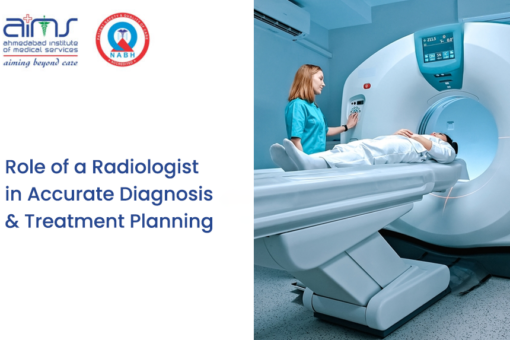
Role of a Radiologist in Accurate Diagnosis & Treatment Planning

We would imagine a life-saving medical intervention and immediately come to picture a doctor operating in the light or an emergency doctor making decisions in a split second. But behind virtually every great medical success tale is a practitioner who does not see the limelight: the radiologist. The role of a radiologist has changed in the contemporary healthcare system of 2026, where the responsibility to read X-rays has changed to being a primary consultant in proper diagnosis and planning of treatment. They are the care designers and present the plan on which all other care is designed. Doctors would be moving around the human body blindly without them. Who is who? Radiologists vs. Radiologic Technologists It is good to clarify a misconception to see why the radiologist is important. It is the person who works on the large MRI or CT machine who has much interaction with many patients. That specialist is the radiologic technologist. Imagine it were a film production of high quality: The technologist is the cinematographer. They are the specialists in technology, positioning the patient, and recording the best quality footage whilst keeping him safe and comfortable. The director and the head analyst is the radiologist. They are medical doctors (MDs) who have gone through more than ten years of training in order to decipher that footage. They do not simply see a picture; they interpret complicated data into a conclusive medical report that determines the further actions of a patient. How Radiologists Ensure a High Degree of Diagnostic Accuracy The road to recovery starts with a solution. The difference between a specific cure and a hazardous delay is an accurate diagnosis. Radiology is a process in which radiologists combine clinical skills and technology to do it. Seeing the Unseen Radiologists identify those issues that cannot be seen in a physical examination, including micro-fractures, small tumors or vascular blockages. With the help of the latest modalities such as 3 and 4D imaging they are able to view the human body in sections and observe the appearance of an organ not only in its appearance, but the most significant thing is that it helps to see how an organ works as it is. The Integration of AI as a “Co-Pilot” Augmented intelligence has transformed the field in the year 2026. The algorithms of AI are now considered a kind of digital safety net, examining thousands of images at once to identify an emergency, such as a stroke or a pulmonary embolism. This does not mean that the doctor will be relieved of his position, just that the radiologist will be able to use his human skills on the extremely complicated cases and the AI will take the responsibility of triaging the high number. Snippet Case Study: Evidence captured in the last couple of years reveals that in situations where radiologists collaborate with artificial intelligence, the rates of early-stage breast cancer detection have gone up substantially, with one identifying the so-called minimal sign cancers that would have been unnoticed ten years ago. The Art of Differential Diagnosis. When you see a spot on a lung scan it does not necessarily mean you have a tumor. It may be an old scar, infection and an innocent cyst. A radiologist applies the term of differentiating diagnosis to eliminate possibilities on the basis of density, blood circulation pattern and the medical history of a patient. This accuracy will save the patient from needless surgeries and guarantee the patient is treated accordingly at the start. Moving Beyond the Image: Radiologists in Treatment Planning The work of a radiologist is not over when the report has been signed. They are engaged in multidisciplinary teams (MDTs), which include oncologists, surgeons, and cardiologists to strategize the “attack” as well. The Roadmap for Surgery A surgeon examines the 3D reconstructions of the radiologist before he makes the first incision. In complicated operations, like heart valves replacement or brain tumor rejection, these pictures serve as a rehearsal. They demonstrate the position of important nerves and blood vessels precisely, which minimizes the chances of complications. Interventional Radiology: The Game Changer One of the most adventurous developments is, possibly, Interventional Radiology (IR). These experts do not diagnose only; they treat. IRs can use real-time imaging to use tiny catheters and needles to: Ablate tumors: Open surgery Freezes or burns a tumor. Do Angioplasty: Opening the blocked arteries with the help of little balloons and stents. Embolization: The removal of blood flow to a fibroid or a tumor so as to reduce its size. These surgeries can take a minute-long incision in the skin and the patient could be sent home the same day which is a far better thing than the weeks of healing that traditional surgeries have them spending. Why You Should Care Who Reads Your Scans? Under the new teleradiology you could find yourself having your scans read by a doctor hundreds of miles away. Although this enhances access, the experience on the other side of that screen is important. There is a sub-specialization known as sub-specialized radiology; the sub-specialist becomes specialized in either the brain (neuroradiology), children (pediatric radiology), or the heart (cardiovascular radiology). When a radiologist makes a quality report, he is not merely stating a problem, but is giving a prognosis and a road to health. Conclusion The role of a radiologist is to provide a solution to a symptom. They will combine the strength of high-technology equipment and the wisdom of medical intuition to make sure that proper diagnosis and treatment planning is not only a dream but a reality of each patient. Whenever you are presented with a medical report next time, keep in mind the specialist who did it behind the scenes so that no one could see what he could not. The recovery of yours is based on their insight.
Posted by Aims Hospital