
Joint stiffness, joint pain swelling, joint pain, and restricted mobility are some of the most common physical ailments that people face as they get older as they play sports or lead busy lives. Many of these issues appear as if they aren’t there as a small ache after walking for a long time or a persistent pain in the knee after a climb as well as a shoulder or knee that cannot be lifted without discomfort.
When traditional treatments such as rest, physiotherapy or medication don’t provide lasting relief, many people and families from Ahmedabad are looking for specific solutions. The most efficient and increasingly trusted way to identify and treat joint pain is arthroscopy which is a minimally invasive procedure for orthopedics that has revolutionized the way joint issues are treated.
In this guide that is comprehensive we’ll look at:
- What exactly is arthroscopy surgery?
- How does it work
- The conditions it treats
- The advantages compared to traditional surgical procedures.
- What can patients expect prior and following surgery?
- Common misinterpretations and errors
This blog is informative, useful, informative, and geared to answer the most common concerns people face when thinking about the arthroscopic joint procedure.
What is Arthroscopy Surgery?
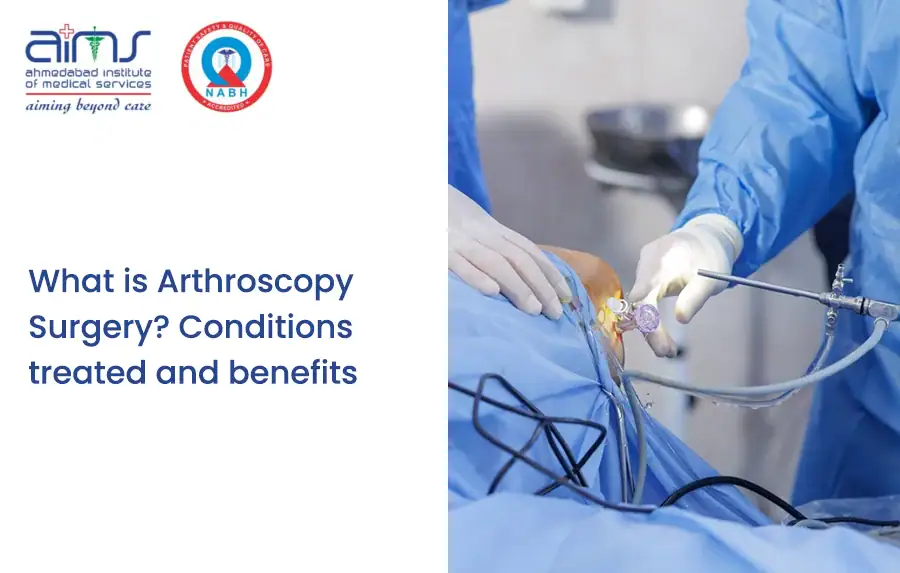
Arthroscopy, which is a simple term, is a minimally-invasive surgical procedure that allows surgeons to examine the inside of a joint by using a tiny camera dubbed an arthroscope. Instead of making a massive incision like in traditional open surgery, surgeons make several small cuts similar to the buttonhole, into which the arthroscope and other specialized instruments are placed. The equipment transmits high-definition pictures from the interior of the joint onto a screen, providing the surgeon with an unobstructed and magnified view of the problematic area.
The term “arthroscopy” is literally “to examine the joint”. Its roots lie in the desire to minimize the trauma of patients and speed up recovery as compared to traditional surgeries for open joints.
Since the procedure is not invasive invasive, it’s typically performed as an outpatient procedure that means patients can return home on the next day and provides precision that advanced imaging techniques such as MRI and CT scans are not able to match.
What is Arthroscopy Surgery Works
To better understand how arthroscopy operates imagine a scenario which involves a tiny flexible camera that has the aid of a light source, is moved into the joint via an incision of a tiny size. The surgeon can view the video of the joint’s interior. They are able to navigate instruments that are specially designed to repair any damage.
Here’s a quick overview of the process:
- Anesthesia & Preparation
Prior to surgery, patients are given anesthesia. It could be local (numbing only the joint) or regional (numbing an entire area) or general (you are asleep during the entire procedure). - Small Incisions
Instead of making a big cutting, the doctor instead makes several tiny cuts, each one just big enough to accommodate an Arthroscope, or the surgical instrument. - Camera Insertion
The arthroscope (with cameras and lights) is put inside the joint. Liquid can be utilized to increase the joint’s space to provide better visibility. - The Real-Time Assessment of and Treatment
After entering the surgical area, the surgeon will examine the structures, including ligaments, cartilages as well as tendons and synovial tissue. If any treatment is needed, for example, cutting a meniscus that has ruptured and smoothing out rough cartilage that can be performed during the same procedure. - Dressing and Closure
Instruments are taken off, cuts are closed and the dressings are put on. Rehabilitation and recovery begin shortly following the procedure.
Since the procedure requires only small incisions and doesn’t require the damage to tissues and muscles surrounding it, patients generally feel less discomfort after surgery and a faster recovery time as compared to traditional open joint surgery.
Common Conditions treated by Arthroscopy
Arthroscopy does not only address the specific type of joint or issue. Orthopedic surgeons certified in this method can utilize it to identify and treat joint problems across a range of joints, including hip, shoulder, knee and elbow, wrist, and ankle.
Here are a few of the most frequently treated conditions that can be managed with an arthroscopic surgical procedure:
1. Meniscus as well as Cartilage Tears in the Knee
Menisci are the cartilage pads in the knee, which take on shock and help provide stability to movements. They can tear due to sports trauma, abrupt twists or wear due to age. Arthroscopy not only helps visualize the exact injury, but it can also allow the surgeon to repair or trim the tissues that have been damaged precisely.
2. Ligament-related Injuries
The most well-known example is the anterior cruciate ligament (ACL) injury, which is typically experienced by athletes. Arthroscopy permits repair or reconstruction of ligaments that have ruptured with less trauma to the patient, allowing them to regain strength and stability faster.
3. Tears of the Shoulder Rotator Cuff and Impingement
In the shoulder area, arthroscopy is able to identify as well as treat injuries in the rotator cuff and remove bone spurs and also release the tissues that are causing shoulder impingement syndrome by making tiny incisions using precise instruments.
4. Bone Fragments, loose Bodies, or Loose Bodies
Sometimes, tiny pieces of cartilage or bone split and can float around a joint due to an injury or degeneration. They can result in clicking, catching, or even pain. Arthroscopy lets the surgeon locate and remove the pieces of tissue without making a huge cut.
5. Inflammation and Synovitis
Inflammation of the joint’s lining, also known as synovitis, may be a result of arthritis or chronic irritation. Arthroscopy permits both diagnosis and treatment of the inflamed tissue to alleviate pain and improve mobility.
6. Elbow, Wrist and Ankle Ailments
Beyond the shoulder and knee the arthroscopy procedure can treat cartilage wear, ligament tears, cysts, instability, and inflammation in the elbow, wrist and ankle when other treatments haven’t brought long-lasting relief.
The reason arthroscopy is beneficial is the fact that many ailments that previously required large surgery, and invasive procedures are now treated with the same way as diagnosis — reducing time and reducing the risk of trauma.
Advantages and benefits Arthroscopy Surgery
The advantages of an arthroscopy procedure over open joint surgery are substantial and can be beneficial for everyone -not only athletes or those who perform at a high level.
Smaller Scars and Minimal Invasiveness
Since only tiny cuts are cut, the joint is only a small damage to the muscles and tissue that surround the joint. This means that:
- Less blood loss during surgery
- Smaller scars afterward
- A lower risk of complications due to wounds that are large
Patients frequently report that the reduction in physical trauma can lead to a better emotional recovery.
Lower Post-Operative Pain
Less incisions, and less damage result in less pain following the procedure. Patients typically require less medication for pain and experience an easier recovery.
Speedier Recovery Time
A major and well-known advantage of arthroscopy has to do with the speed of recuperation. Patients can often return to normal routines in just a few days instead of months or weeks. Many athletes appreciate the ability to resume training faster, and those who rely on physical activity are able to resume work quicker.
Lower risk of infection and Complications
Less incisions means lesser exposure for internal organs to bacteria from the outside. This, in conjunction with shorter times for procedures as well as less trauma to the general area reduces the chance of infection as well as certain surgical complications.
High-Resolution Real-Time Video and Accurate
The arthroscope’s high definition imaging provides surgeons a clear and magnified view of complex joint structures. This assists in identifying subtle issues that do not be apparent on scans, and also in making them more effective during this same process.
Treatment for outpatients and cost benefits
In most cases it is done on an outpatient basis which means you are able to return home on the next day. This helps reduce hospitalizations and overall healthcare costs and the risk of contracting hospital-acquired infections as well as giving patients the security of recuperating in a familiar setting.
What to Expect Prior to and Following Arthroscopy
Before Surgery
Prior to undergoing arthroscopy surgery your surgeon will review the symptoms you are experiencing, look over information about your health history and conduct imaging tests such as MRIs to determine the joint’s pathology. If the tests don’t reveal the full picture, then arthroscopy could be the best method to determine and treat concurrently.
There will be instructions on the need to fast, medications and the preparation needed for anesthesia. Be aware that arthroscopy is an extremely risky surgical procedure even though it’s minimally risky, so preparation for post-operative care is vital.
After Surgery
The extent of recovery will depend on the joint that was treated as well as the extent and extent of repair. In general:
- You can go home on the same day, or after an in-hospital stay of just a few hours.
- Expect some swelling and discomfort for a couple of days.
- Physical therapy is vital. A plan for rehabilitation that is structured will help strengthen and restore flexibility.
- Then you’ll be able to return to your daily tasks and work quicker than you would with conventional surgical procedures.
Many patients are misled into thinking that the procedure is the “quick fix” however it is a process that requires disciplined post-operative care and physical therapy to get the most long-term benefits.
Common Misconceptions and Errors
An error that is often made is to delay medical examinations and assume that the symptoms will resolve by themselves. Joint pain is rarely resolved without intervention, particularly if discomfort, instability or locking continue to recur.
Another myth is that arthroscopy will fix every problem in a flash. Although it can provide significant benefits, it’s not able to reverse arthritis or joint degeneration on its own. In certain situations a joint replacement might be the best option A specialist can assist you in making that choice in the event of need.
Additionally, avoiding the physical therapy following surgery is not a good idea. Rehabilitation is as crucial as the procedure itself to restore joint function.
Arthroscopy Surgery in Ahmedabad: Practical Aspects
For residents of Ahmedabad and surrounding regions the accessibility to skilled orthopedic services has risen dramatically over time. Finding an accredited orthopedic surgeon for arthroscopy in Ahmedabad requires collaborating with experts who know the anatomy of joints, needs for recovery and individualized treatment plans.
Your surgeon should take the time to clarify:
- If arthroscopy is the best option
- What is the procedure?
- What do realistic timelines for recovery will
- The potential risks and the way they’re handled
A skilled surgeon will tailor his treatment to your particular condition as well as your overall health and your goals for living.
Conclusion
Arthroscopy surgery is a modern advancement in joint care by combining high-tech imaging, precision instruments, and a minimally invasive procedure to diagnose and treat joint issues that used to require huge, traumatizing procedures. It can be a great benefit in terms of recovery times, pain as well as outcomes when done in the correct circumstances and with appropriate post-operative treatment.
If you or someone close to you have been suffering from joint pain, limited mobility, or signs that don’t improve with traditional treatment, seeking out an experienced arthroscopy surgeon in Ahmedabad will give you guidance and clarity. A prompt evaluation and a thoughtful plan will help you get to more joint health and a more active, enjoyable life. For individuals seeking advanced and patient-focused joint care, AIMS Care Hospital in Ahmedabad offers modern arthroscopy services supported by experienced orthopedic specialists and advanced surgical technology. The hospital focuses on accurate diagnosis, minimally invasive treatment, and structured rehabilitation programs to help patients recover safely and return to their daily activities with confidence.
